




In the world of high-precision motion control, even the smallest vibration or inconsistency can make a significant difference. This is where slotless linear motors stand out, offering ultra-smooth motion, high speed, and exceptional accuracy without the limitations of traditional designs.
But what exactly is a slotless linear motor, and why is it becoming the preferred choice in industries like semiconductor manufacturing, medical technology, and advanced automation? In this article, we’ll break down its structure, explain how it works, and uncover the key advantages that make it a powerful solution for modern engineering applications.
What is a Slotless Linear Motor?
A slotless linear motor is a type of direct-drive linear motor designed without iron slots in its stator, using an ironless coil that moves within a magnetic field generated by permanent magnets. Unlike conventional linear motors that rely on iron-core structures, slotless designs eliminate the physical interaction between iron teeth and magnets, resulting in significantly smoother and more precise motion.
At its core, a slotless linear motor operates based on the same principle as other linear motors: it converts electrical energy directly into linear motion without the need for mechanical transmission components such as ball screws, belts, or gears. This “direct drive” approach not only simplifies the system architecture but also minimizes friction, wear, and backlash, common issues in traditional motion systems.
What truly sets slotless linear motors apart is their cogging-free performance. In iron-core motors, the presence of slots can create unwanted magnetic attraction forces, leading to motion ripple or vibration (known as cogging). By removing these slots entirely, slotless motors achieve ultra-smooth, continuous motion, making them ideal for applications where precision and consistency are critical.
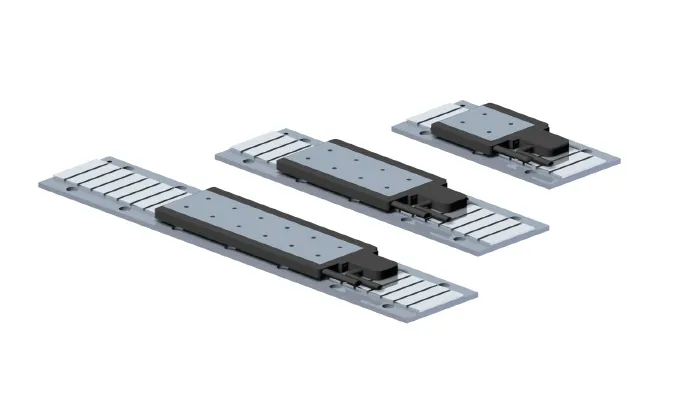
Additionally, the absence of an iron core significantly reduces moving mass and eliminates magnetic attraction forces between the coil and the magnet track. This allows for:
- Faster acceleration and deceleration
- Lower heat generation
- Improved control responsiveness
Because of these characteristics, slotless linear motors are widely used in industries that demand high performance and reliability, such as semiconductor manufacturing, medical equipment, precision assembly, and inspection systems.
In summary, a slotless linear motor is not just a variation of a traditional motor, it is a high-performance motion solution engineered for applications where smoothness, precision, and dynamic response are non-negotiable.
Structure of a Slotless Linear Motor
To fully understand why slotless linear motors deliver such smooth and precise motion, it’s essential to look at their unique structure. Unlike traditional designs that rely on iron cores and slotted stators, slotless linear motors use a simplified yet highly optimized architecture that minimizes magnetic interference and mechanical constraints.
Main Components
A typical slotless linear motor consists of three key elements:
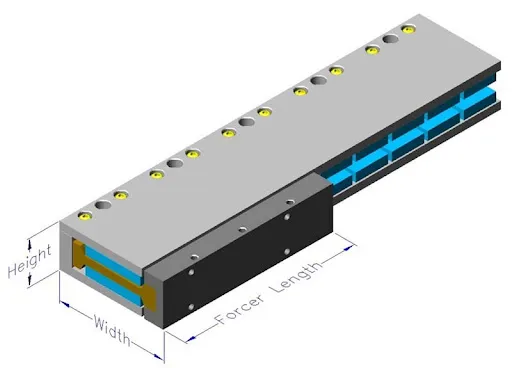
- Ironless Coil (Moving Part): The coil is the active component responsible for generating force. In slotless designs, it is completely iron-free, meaning there is no ferromagnetic material inside. This significantly reduces weight and eliminates unwanted magnetic attraction forces.
- Magnet Track (Stationary Part): The magnet track is made up of high-strength permanent magnets, usually arranged in an alternating north-south pattern. This creates a consistent magnetic field along the motion path, allowing the coil to move smoothly and continuously.
- Feedback System (Encoder): An encoder is typically integrated to provide real-time position feedback. This ensures high accuracy and enables precise control of speed, position, and acceleration, especially critical in high-end automation systems.
Ironless Design Explained
The defining feature of a slotless linear motor lies in its ironless construction. Unlike iron-core motors that use laminated steel to guide magnetic flux, slotless motors rely solely on the interaction between the coil and the magnetic field.
This design brings several important advantages:
- No cogging effect → eliminates vibration and motion ripple
- Zero magnetic attraction force → easier mechanical integration
- Lower heat buildup → improved thermal performance and system stability
Because there is no iron to concentrate magnetic flux, the motor operates more smoothly, albeit with slightly lower force density compared to iron-core alternatives.
Slotless linear motors can be configured in different mechanical layouts depending on the application:
- Moving Coil Design: The coil moves while the magnet track remains fixed. This is the most common configuration, offering low moving mass and excellent dynamic response.
- Moving Magnet Design: The magnet assembly moves while the coil stays stationary. This setup is less common but can be useful in applications where cable management or thermal considerations are critical.
Each configuration has its own advantages, but both maintain the core benefit of frictionless, direct linear motion.
In essence, the structure of a slotless linear motor is engineered for simplicity and performance. By removing iron components and reducing mechanical complexity, it achieves a level of smoothness and precision that is difficult to match with conventional motor technologies, making it an ideal choice for advanced motion control applications.
Working Principle of Slotless Linear Motors
Understanding the working principle of a slotless linear motor helps explain why it delivers such smooth, precise, and highly responsive motion. At its core, this type of motor operates based on a well-established electromagnetic concept, the Lorentz force principle, which describes how a current-carrying conductor behaves inside a magnetic field.
1. Electromagnetic Force Generation
When an electric current flows through the ironless coil, it generates a magnetic field. This field interacts with the magnetic field produced by the permanent magnets in the track. As a result, a force is generated, known as the Lorentz force, which pushes the coil in a linear direction.
Because the coil is not constrained by iron slots, this interaction occurs smoothly and continuously along the entire length of the motor.
2. Step-by-Step Motion Process
The motion of a slotless linear motor can be broken down into a simple sequence:
- Current Input: An electric current is supplied to the coil through a drive system.
- Magnetic Field Interaction: The current-carrying coil is exposed to the magnetic field of the permanent magnets.
- Force Generation: The interaction between these two magnetic fields produces a linear force.
- Controlled Movement: By precisely controlling the current (magnitude and direction), the motor can achieve accurate positioning, speed, and acceleration.
3. Why Motion is Ultra-Smooth
One of the most important advantages of slotless linear motors comes directly from their working principle:
- No cogging effect: Without iron slots, there are no periodic magnetic attraction forces interrupting motion.
- Continuous force output: The generated force remains consistent along the entire stroke.
- Minimal vibration: This makes the motor ideal for applications requiring extreme stability and precision.
4. Comparison to Rotary Motors
A helpful way to visualize a linear motor is to think of it as an “unrolled rotary motor.”
- In a rotary motor: motion is circular (rotation)
- In a linear motor: the same electromagnetic principle is applied in a straight line
By eliminating the need to convert rotary motion into linear motion (via screws or belts), slotless linear motors achieve:
- Higher efficiency
- Faster response
- Greater positioning accuracy
5. Dynamic Performance and Control
Because of their lightweight ironless coils and direct-drive design, slotless linear motors offer:
- High acceleration and deceleration
- Fast response to control signals
- Precise synchronization with feedback systems (encoders)
This makes them especially suitable for advanced automation systems where speed and accuracy must be tightly controlled.
In summary, the working principle of slotless linear motors is elegantly simple yet incredibly powerful. By leveraging direct electromagnetic force without the constraints of iron-core structures, these motors deliver unmatched smoothness, responsiveness, and precision, key factors in modern high-performance motion systems.
Key Advantages of Slotless Linear Motors
Slotless linear motors are widely recognized for their superior performance in high-precision motion systems. Thanks to their ironless design and direct-drive operation, they offer a range of advantages that make them a preferred choice in advanced industries such as semiconductor manufacturing, medical technology, and automation.
Below are the key benefits that set them apart from conventional motor solutions.
1. Ultra-Smooth Motion
One of the most significant advantages of slotless linear motors is their cogging-free performance.
Because there are no iron slots in the stator, the motor eliminates the magnetic attraction forces that typically cause vibration and motion ripple in iron-core designs. This results in:
- Exceptionally smooth and continuous motion
- Reduced vibration and noise
- Improved surface quality in precision manufacturing processes
This level of smoothness is especially critical in applications like wafer processing or optical inspection, where even the slightest disturbance can impact performance.
2. High Precision and Accuracy
Slotless linear motors are engineered for ultra-precise positioning. When combined with high-resolution feedback systems such as encoders, they can achieve extremely fine motion control.
Key benefits include:
- Sub-micron positioning accuracy
- Excellent repeatability
- Stable performance over long operating periods
These characteristics make them ideal for industries that demand tight tolerances, such as medical device manufacturing and microelectronics assembly.
3. Zero Cogging and No Attraction Force
Unlike iron-core linear motors, slotless designs generate virtually zero magnetic attraction force between the coil and the magnet track.
This provides several practical advantages:
- Easier and more flexible mechanical design
- Reduced load on bearings and guide systems
- Lower maintenance requirements
By eliminating these unwanted forces, engineers can design lighter and more efficient motion systems without compromising stability.
4. High Dynamic Performance
The ironless coil used in slotless linear motors is significantly lighter than traditional iron-core components. This leads to outstanding dynamic capabilities, including:
- High acceleration and deceleration rates
- Rapid response to control signals
- Improved throughput in high-speed applications
As a result, these motors are well-suited for systems that require fast and precise movements, such as pick-and-place machines or high-speed inspection equipment.
5. Low Heat Generation and Better Thermal Management
Another important advantage is reduced heat generation. Since there is no iron core, the motor avoids core losses commonly found in traditional designs.
This results in:
- More efficient energy usage
- Lower operating temperatures
- Improved system stability and longevity
Better thermal performance also means less need for complex cooling systems, simplifying the overall machine design.
6. Reduced Mechanical Wear and Maintenance
As a direct-drive solution, slotless linear motors eliminate the need for mechanical transmission components such as gears, belts, or lead screws.
This leads to:
- Minimal mechanical wear
- Reduced maintenance costs
- Longer system lifespan
Fewer moving parts also mean fewer potential points of failure, increasing overall reliability.
In summary, the advantages of slotless linear motors go far beyond just smooth motion. They offer a powerful combination of precision, efficiency, reliability, and flexibility, making them an essential technology for modern high-performance motion control systems.
Applications of Slotless Linear Motors
Slotless linear motors are increasingly being adopted across a wide range of high-tech industries where precision, smooth motion, and reliability are critical. Thanks to their cogging-free performance and direct-drive design, they enable engineers to push the limits of accuracy and efficiency in demanding applications. Below are some of the most prominent use cases where slotless linear motors truly excel:
- Semiconductor manufacturing equipment, where ultra-smooth and vibration-free motion is essential for processes such as wafer handling, lithography, and inspection systems
- Medical devices and laboratory automation, supporting applications like imaging systems, diagnostic equipment, and precision drug delivery where accuracy and quiet operation are crucial
- Precision assembly and electronics manufacturing, enabling high-speed, high-accuracy positioning for assembling small and delicate components
- CNC machines and micro-machining systems, where consistent motion and fine control directly impact surface quality and machining precision
- Robotics and automated production lines, particularly in pick-and-place systems that require rapid acceleration, repeatability, and smooth trajectory control
- Optical and inspection systems, where even the smallest vibration can affect measurement accuracy, making slotless motors an ideal solution
- Packaging and high-speed sorting systems, helping improve throughput while maintaining precise control over product movement
- Aerospace and advanced research applications, where high-performance motion systems are needed for testing, simulation, and specialized engineering tasks
From cleanroom environments to high-speed production lines, slotless linear motors continue to redefine what is possible in motion control. Their ability to deliver seamless, precise, and reliable movement makes them not just a component, but a key enabler of innovation across modern industries.
Conclusion
In an era where precision, speed, and reliability define technological progress, slotless linear motors have emerged as a game-changing solution for advanced motion control. By eliminating the limitations of traditional iron-core designs, they deliver an exceptional combination of ultra-smooth motion, high accuracy, and dynamic performance, making them indispensable in today’s most demanding industries.
From semiconductor fabrication to medical innovation and high-speed automation, slotless linear motors are not just improving how machines move, they are redefining what machines can achieve. Their ability to operate with minimal vibration, reduced wear, and outstanding efficiency opens the door to smarter, faster, and more precise systems.

