




In high-precision automation, speed alone is no longer enough. What truly defines system performance today is how fast a motor can respond, not just move. This is where high frequency response linear motors come into play. Designed to react instantly to control signals, suppress vibration, and maintain accuracy even under rapid motion changes, these motors are redefining what is possible in advanced motion control systems. But what exactly makes a linear motor “high frequency response,” and why is it becoming a critical component in next-generation industrial equipment?
What Is a High Frequency Response Linear Motor?
A high frequency response linear motor is a direct-drive linear motion system designed to respond rapidly and accurately to high-speed control commands with minimal delay or signal loss. In motion control terms, “high frequency response” refers to the motor’s ability to follow rapid changes in position, velocity, or force commands while maintaining stability, precision, and smooth motion.
Unlike conventional linear motors or rotary systems that rely on mechanical transmission components such as ball screws, belts, or couplings, high frequency response linear motors generate thrust directly through electromagnetic force. This direct-drive structure eliminates mechanical inertia, backlash, and compliance, factors that typically limit dynamic performance and control bandwidth in traditional systems.
At the core of a high frequency response linear motor is its exceptional dynamic behavior. The motor can accelerate, decelerate, and reverse direction within extremely short time intervals, allowing it to track high-frequency motion profiles with high fidelity. This capability is critical in applications where even micro-delays or slight oscillations can compromise accuracy, throughput, or product quality.
From a control perspective, high frequency response linear motors are optimized for wide servo bandwidth and fast current response. Advanced magnetic circuit design, lightweight moving elements, and high-resolution feedback systems enable the motor to react almost instantaneously to control inputs from the servo drive. As a result, phase lag is minimized, and the commanded motion is executed with exceptional precision.
In practical terms, a high frequency response linear motor excels in environments that demand:
- Rapid point-to-point positioning with tight settling times
- Continuous high-speed motion with minimal vibration
- Accurate force and position control under rapidly changing loads
Because of these characteristics, high frequency response linear motors are increasingly used in high-end automation systems such as semiconductor equipment, precision inspection platforms, laser processing machines, and advanced electronic manufacturing lines, where both speed and control accuracy are non-negotiable.
Key Features of High Frequency Response Linear Motors
High frequency response linear motors are not simply designed to move faster, they are engineered to react smarter. What sets them apart is a combination of advanced electromagnetic design, precision control, and dynamic performance that conventional motion systems cannot match.
- Ultra-fast dynamic response: The motor can follow rapid changes in position, speed, and force commands with minimal delay, ensuring precise execution even in high-frequency motion profiles.
- High acceleration and deceleration capability: With a lightweight moving element and direct thrust generation, the motor achieves extreme acceleration rates, dramatically reducing cycle times in high-speed automation processes.
- Wide control bandwidth: Optimized for high-frequency servo control, these motors maintain stable and accurate motion across a broad operating range, even during rapid start-stop or direction reversal.
- Exceptional positioning accuracy and repeatability: When paired with high-resolution linear encoders, high frequency response linear motors deliver micron- or sub-micron-level precision with consistent repeatability.
- Minimal vibration and smooth motion: Direct-drive architecture eliminates mechanical backlash and compliance, resulting in smooth, low-ripple motion and superior vibration suppression.
- High force density: Advanced magnetic circuit design enables strong, linear thrust output within a compact footprint, supporting both high-speed and high-load applications.
- Zero mechanical wear components: The absence of screws, belts, and gears significantly reduces maintenance requirements and improves long-term reliability.
- Thermal stability at high operating frequencies: Efficient heat dissipation and optimized coil design help maintain consistent performance during continuous high-speed operation.
Together, these features make high frequency response linear motors a cornerstone technology for next-generation precision automation, where speed, accuracy, and control must work in perfect synchronization.
How High Frequency Response Linear Motors Work
High frequency response linear motors operate based on a direct electromagnetic drive principle, converting electrical energy directly into linear motion without any intermediate mechanical transmission.
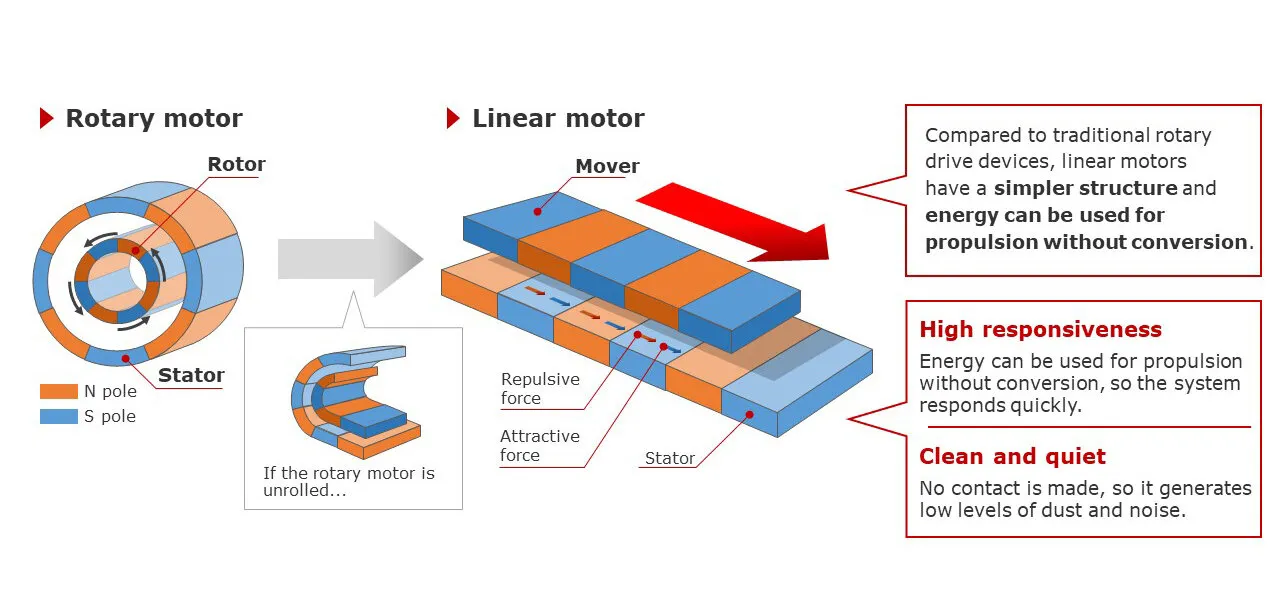
This fundamental design is the key factor that enables ultra-fast response, high control bandwidth, and exceptional motion accuracy.
Direct Drive Electromagnetic Force Generation
At the most basic level, a high frequency response linear motor consists of two primary components: a magnetic track (stator) and a moving coil or magnet assembly (forcer). When current flows through the motor windings, it interacts with the magnetic field to produce linear thrust according to the Lorentz force principle.
Because thrust is generated directly along the axis of motion, there is no need for rotary-to-linear conversion mechanisms such as screws or belts. Eliminating these components significantly reduces mechanical inertia, friction, and elastic deformation, three major sources of delay and vibration in conventional motion systems.
Lightweight Moving Structure for Rapid Acceleration
High frequency response linear motors are engineered with an ultra-light mover design. By minimizing the mass of the moving element, the motor can achieve extremely high acceleration and deceleration rates with minimal force. This low moving mass allows the motor to respond instantly to rapid command changes, even at high operating frequencies.
A lightweight mover also improves system stability, reducing overshoot and settling time during high-speed positioning tasks. This is especially important in applications that require frequent start-stop cycles or rapid direction changes.
Wide Servo Bandwidth and Fast Current Control
Another critical factor behind high frequency response performance is wide servo bandwidth. High-performance servo drives and advanced current control algorithms allow the motor to regulate force output at very high frequencies.
Fast current loop response ensures that commanded thrust is generated almost instantaneously, minimizing phase lag between control input and mechanical output. This tight synchronization between electrical and mechanical systems enables precise tracking of complex motion profiles, including high-frequency oscillations and micro-positioning tasks.
High-Resolution Feedback and Real-Time Control
High frequency response linear motors rely on high-resolution position feedback devices, such as optical linear encoders or advanced magnetic encoders. These feedback systems continuously monitor the motor’s position and velocity with extreme accuracy.
Real-time feedback allows the controller to make rapid, fine adjustments to the motor’s output, suppressing vibration and maintaining motion stability even under dynamic load changes. The result is smooth, accurate motion across the entire operating speed range.
Optimized Magnetic and Thermal Design
To maintain performance at high operating frequencies, the magnetic circuit of the motor is carefully optimized to deliver high force density with low cogging and ripple. At the same time, efficient thermal management, through natural or forced cooling, ensures consistent performance during continuous high-speed operation.
Effective heat dissipation prevents thermal drift, which can otherwise degrade accuracy and response speed over time.
Advantages Over Conventional Motion Systems
When compared with traditional motion systems such as ball screw drives, belt-driven stages, or rotary motor assemblies, high frequency response linear motors deliver a clear performance advantage. Their benefits extend beyond speed, fundamentally improving accuracy, stability, and system efficiency.
- Faster system response thanks to direct electromagnetic drive, allowing motion commands to be executed almost instantly without mechanical delay.
- Higher positioning accuracy and repeatability by eliminating backlash, elastic deformation, and transmission errors common in mechanical drive systems.
- Shorter cycle times achieved through rapid acceleration and deceleration, significantly improving productivity in high-speed automation environments.
- Superior motion stability at high speeds, with smoother trajectories and reduced vibration even during frequent start-stop or direction-changing operations.
- Reduced mechanical complexity by removing screws, belts, gears, and couplings, simplifying system design and integration.
- Lower maintenance requirements due to the absence of contact-based transmission components, resulting in improved reliability and longer service life.
- Improved energy efficiency in dynamic applications, as power is used directly for motion rather than overcoming mechanical friction and inertia.
- Greater design flexibility for machine builders, enabling compact layouts and optimized machine architectures without mechanical constraints.
Together, these advantages make high frequency response linear motors an ideal solution for applications where conventional motion systems struggle to meet demanding requirements for speed, precision, and dynamic control.
Typical Applications of High Frequency Response Linear Motors
High frequency response linear motors are widely adopted in industries where motion speed, precision, and dynamic stability directly impact performance and product quality. Their ability to execute rapid, accurate movements makes them especially valuable in advanced automation and high-end manufacturing environments.
- Semiconductor manufacturing equipment, where ultra-fast positioning and vibration-free motion are essential for wafer handling, lithography, and inspection processes.
- Precision inspection and metrology systems that require stable, high-resolution motion to achieve reliable measurement accuracy at high scanning speeds.
- High-speed pick-and-place machines used in electronics and micro-component assembly, enabling shorter cycle times and improved throughput.
- Laser cutting, marking, and micro-machining systems that demand smooth, high-frequency motion control to maintain processing quality and edge precision.
- Medical and laboratory automation equipment, where precise, repeatable motion supports reliable sample handling, diagnostics, and analysis.
- Electronics manufacturing and testing lines that benefit from rapid motion response during probing, soldering, and functional testing operations.
- Advanced industrial automation systems designed for continuous high-speed operation with strict accuracy and repeatability requirements.
Across these applications, high frequency response linear motors enable machine builders and manufacturers to push the limits of speed and precision while maintaining consistent, stable motion performance.
Conclusion
As industrial automation continues to evolve toward higher speeds, greater precision, and smarter control, motion systems are being pushed beyond the limits of conventional technology. High frequency response linear motors represent a decisive step forward in this transformation. By combining direct-drive architecture, rapid dynamic response, and exceptional motion stability, they enable machines to perform with a level of accuracy and efficiency that traditional motion systems simply cannot achieve.
More than a performance upgrade, high frequency response linear motors provide a foundation for next-generation equipment design. They empower engineers and manufacturers to reduce cycle times, improve product quality, and build more compact, reliable, and responsive machines capable of meeting increasingly demanding production requirements.

