




Choosing the right high torque servo motor can make or break the performance of your automation system. From robotic arms that require precise, powerful movements to heavy-duty packaging lines that run at high speed, the motor you choose directly affects productivity, efficiency, and long-term stability.
Yet, with dozens of torque ratings, encoder options, and control configurations available, many businesses still struggle to select a servo that truly fits their operational needs. This guide breaks down the essential criteria you must consider, helping you avoid costly mistakes and confidently identify the best high torque servo motor for your application. Let’s make your system stronger, smarter, and more reliable from the very first step.
What Are High Torque Servo Motors?
High torque servo motors are specialized servo systems designed to deliver significantly higher rotational force compared to standard servo motors. They are built for applications where machines must handle heavy loads, maintain stability under high stress, or accelerate rapidly without losing precision. In industrial automation, these motors act as the “muscle” behind advanced motion control, ensuring powerful yet smooth and accurate movements even in demanding environments.
At their core, high torque servo motors operate using a closed-loop control system. This means the motor constantly receives feedback from encoders, devices that track position, speed, and rotation to adjust its output in real time. The result is highly accurate control, minimal error, and exceptional responsiveness, even during complex or dynamic tasks. Unlike open-loop systems such as stepper motors, servo motors maintain torque more effectively across a wide speed range and avoid issues like stalling or overheating under heavy load.
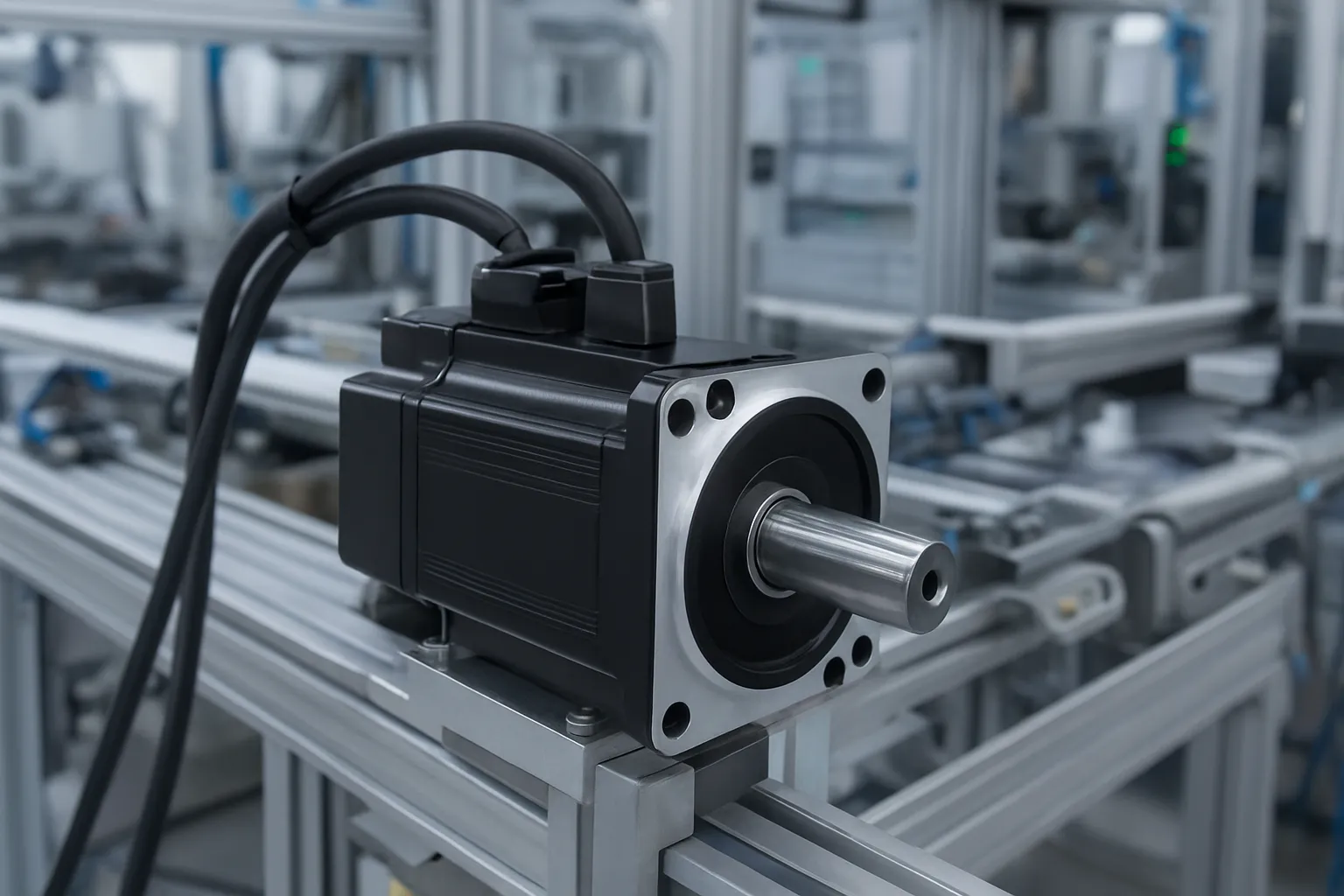
What sets high torque servo motors apart is their ability to deliver both continuous torque and short bursts of peak torque. Continuous torque supports stable long-term operation, while peak torque handles sudden load changes or rapid acceleration. This balance allows machinery to run faster, more efficiently, and with greater reliability, critical factors in industries like robotics, CNC machining, packaging, printing, and material handling.
Because high torque servo motors combine power, precision, and adaptability, they have become a preferred choice for modern automation systems seeking greater performance and energy efficiency. Whether your application requires lifting, pushing, rotating, or indexing under load, these motors provide the consistent force and intelligent control needed to achieve high-quality, high-speed results.
Key Factors to Consider When Choosing High Torque Servo Motors
Selecting the right high torque servo motor is not simply about choosing a model with the highest torque rating. It requires a careful evaluation of how the motor will perform under real operating conditions, how well it matches your mechanical design, and how accurately it supports your motion profile. Below are the essential factors you must assess before making a decision.
1. Torque Requirements: Continuous vs. Peak Torque
When sizing a high torque servo motor, understanding your torque demand is the most critical step. Continuous torque refers to the torque the motor can sustain indefinitely without overheating, while peak torque represents short bursts of torque available for sudden load changes or acceleration sequences. Many engineers mistakenly size motors only based on peak requirements, resulting in inefficiency, higher energy consumption, and premature wear.
To determine the correct torque, you need to evaluate factors such as load mass, friction, acceleration rate, and duty cycle. In applications like CNC machining or robotics, loads often fluctuate rapidly, so balancing continuous and peak torque ensures stable operation. A well-sized motor maintains torque throughout the entire cycle, avoids unnecessary heat buildup, and reduces long-term maintenance.
2. Speed and Acceleration Needs
The relationship between torque and speed is not linear. Every servo motor has a torque-speed curve, and understanding this curve is essential to predicting real-world performance. High torque at low speed may not translate into sufficient torque at higher RPMs, especially in fast-paced automation lines.
When choosing a servo motor, evaluate the full motion profile: acceleration time, deceleration time, target speed, and positioning frequency. Applications such as pick-and-place robotics or high-speed packaging machinery require a motor that can accelerate quickly without torque drop-off. Selecting a motor with a speed range aligned to your motion profile ensures smooth, consistent operation under all load conditions.
3. Inertia Matching Between Motor and Load
Inertia matching is one of the most overlooked yet important factors in servo selection. The inertia ratio, load inertia divided by motor inertia, directly impacts stability, vibration, and control accuracy. A mismatch results in oscillations, overshooting, poor response, and increased energy consumption. In severe cases, the system may become unstable and fail to hold position.
Ideally, the inertia ratio should be within the manufacturer’s recommended range (commonly 3:1 or 5:1, depending on the servo and controller). Proper inertia matching allows the servo to respond quickly, maintain smooth motion, and avoid unnecessary stress on gears and couplings. If the load inertia is too high, gear reduction or structural redesign may be necessary to optimize performance.
4. Power and Voltage Compatibility
High torque servo motors come in various power classes and voltage ratings, such as 24V, 48V, 220V, or even 380V for industrial-grade models. The choice depends on both your electrical system and the motor’s power demand. Undersized power supplies can cause torque drop, slow response, or unexpected shutdowns. Conversely, overspecifying voltage increases cost and may require additional electrical protection.
Consider the full duty cycle of your system: continuous operation, intermittent motion, or heavy acceleration. Motors running under long periods of high load require stable power input and proper thermal design. Selecting the right voltage ensures the motor delivers its rated torque consistently and operates safely within its thermal limits.
5. Accuracy and Control Resolution
One of the defining advantages of servo motors is their precision, which largely depends on encoder resolution and control feedback quality. High torque servo motors often integrate optical or magnetic encoders, available in incremental or absolute types. High-resolution encoders allow the motor to achieve finer positioning, smoother motion, and better repeatability, critical for applications like laser cutting, robotic welding, or semiconductor assembly.
When evaluating encoder options, consider both positioning accuracy and the required control bandwidth. Higher resolution generally means better performance, but your controller must also support the corresponding feedback frequency. For complex motion tasks requiring micron-level precision, absolute encoders with multi-turn capability provide the highest reliability and control depth.
6. Environmental and Operating Conditions
The environment in which the motor operates can significantly affect its lifespan and performance. Factors such as temperature, humidity, dust, vibration, and exposure to water or chemicals must be carefully evaluated. Motors used in food processing, outdoor applications, or dusty industrial sites require higher protection ratings, such as IP65 or above.
Additionally, harsh environments may demand reinforced housings, better heat dissipation, or corrosion-resistant components. Ensuring proper environmental compatibility not only prevents failure but also minimizes downtime and maintenance costs across the equipment’s lifecycle.
7. Size, Mounting Options, and Mechanical Compatibility
Even the best servo motor will underperform if it does not integrate correctly with your mechanical structure. Shaft type, flange size, mounting pattern, and coupling method all determine whether the motor can reliably transfer torque into the system. Incorrect alignment causes excessive wear, noise, and vibration, ultimately reducing motor life.
Consider mechanical constraints early in the design phase, especially in compact machinery, robotic joints, or retrofitting projects. Choosing a motor with the right form factor and mounting configuration guarantees better load transfer, smoother operation, and easier servicing.
Common Mistakes When Selecting High Torque Servo Motors
Choosing a high torque servo motor can be deceptively challenging, and even experienced engineers often fall into avoidable traps. Below are the most common mistakes that lead to poor performance, unnecessary downtime and higher long-term costs.
- Selecting a motor based only on its maximum torque instead of evaluating both continuous and peak torque required for real operating conditions.
- Ignoring inertia matching between the motor and the load, which creates vibration, overshooting and instability throughout the motion profile.
- Overlooking the torque-speed curve and assuming the motor can maintain torque at higher speeds, resulting in slower cycles and reduced efficiency.
- Choosing an encoder with insufficient resolution, causing inconsistent positioning and poor accuracy in applications that require precise motion control.
- Failing to consider environmental conditions such as dust, moisture, temperature or vibration that may shorten the motor’s lifespan.
- Picking a motor with incompatible mounting options or shaft dimensions, leading to misalignment, mechanical stress and premature wear.
- Prioritizing low initial cost over long-term reliability, which often results in more maintenance, more downtime and higher lifetime expenses.
By avoiding these mistakes, businesses can ensure their high torque servo systems run smoother, last longer and deliver the performance their automation workflows truly require.
Recommended Applications for High Torque Servo Motors
High torque servo motors are engineered for demanding motion tasks where power, precision and stability must work seamlessly together. Their strength and responsiveness make them essential across a wide range of industrial applications.
- Robotics systems that require strong, precise joint movements for lifting, gripping or repetitive motion cycles.
- CNC machining equipment such as milling, routing or cutting machines that need stable torque under heavy load.
- Packaging machinery operating at high speed where consistent torque ensures smooth sealing, labeling or palletizing.
- Conveyor and material handling systems that must move heavy items with controlled acceleration and reliable positioning.
- AGVs and AMRs that rely on powerful, responsive motors to handle variable loads and maintain accurate navigation.
- Printing and converting machines that depend on uniform torque for tension control and high-precision output.
- Industrial automation lines where frequent acceleration, deceleration and accurate positioning are essential for productivity.
By applying high torque servo motors in the right scenarios, businesses can achieve greater efficiency, smoother performance and enhanced reliability across their entire automation ecosystem.
Conclusion
Choosing the right high torque servo motor is more than a technical decision, it is a strategic investment in the performance, stability and longevity of your entire automation system. When you understand how torque, speed, inertia, precision and environmental conditions work together, you gain the confidence to select a motor that truly matches your operational demands. Avoiding common mistakes and applying each selection factor thoughtfully ensures your machines run smoother, respond faster and deliver consistently higher output.
As industries push for greater accuracy, higher productivity and smarter automation, high torque servo motors continue to play a critical role in powering modern machinery. Whether you are building advanced robotics, upgrading CNC equipment or optimizing a high-speed production line, the right servo solution will elevate your performance at every level. For businesses seeking expert guidance and reliable motion control solutions, partnering with ITG can help transform complex requirements into efficient, future-ready systems.

