




In modern industrial automation, motion is no longer limited to straight lines or simple rotations. As production systems demand higher speed, greater flexibility, and more compact machine layouts, curved linear motor systems are emerging as a powerful alternative to traditional motion technologies.
By combining the precision of linear motors with the freedom of curved trajectories, these systems enable continuous, contactless motion along complex paths, unlocking new possibilities in machine design, performance optimization, and advanced automation. This article explores the design principles, performance characteristics, and real-world use cases that make curved linear motor systems a strategic choice for next-generation industrial applications.
What Is a Curved Linear Motor System?
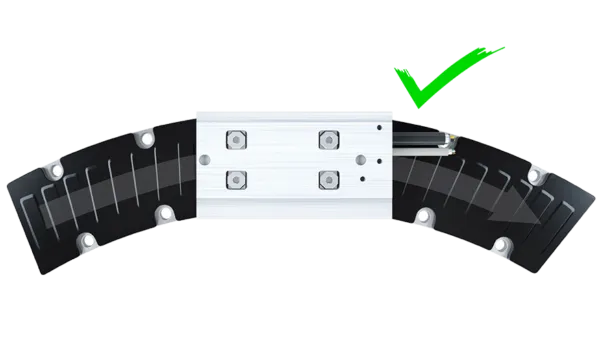
A curved linear motor system is an advanced motion solution that enables direct, contactless linear movement along a non-linear or curved path. Unlike conventional linear motors that operate only on straight tracks, curved linear motor systems are designed to follow arcs, circles, or complex trajectories while maintaining high precision, speed, and dynamic performance.
At its core, a curved linear motor system applies the same electromagnetic principles as a traditional linear motor, generating thrust through the interaction between a magnetic field and an electric current, but adapts the motor geometry to support continuous motion along curved tracks. This allows machines to execute complex motion profiles without relying on mechanical transmissions such as gears, belts, chains, or cam mechanisms.

Key Characteristics of Curved Linear Motor Systems
One of the defining features of curved linear motor systems is their direct-drive architecture. Motion is generated directly between the motor’s stationary track and the moving forcer, eliminating mechanical contact and associated backlash. This results in smoother motion, higher positioning accuracy, and superior repeatability, even at high speeds and accelerations.
Another critical characteristic is path flexibility. Curved linear motor systems can be configured as partial arcs, full circular loops, or modular curved segments combined with straight sections. This modularity enables engineers to design compact, space-efficient machine layouts while maintaining continuous and uninterrupted motion flow.
Main Components of a Curved Linear Motor System
A typical curved linear motor system consists of several key components working in close coordination:
- Curved Motor Track (Stator): The stationary element, shaped to follow a defined radius or complex curve, houses the magnetic structure that generates the driving force.
- Moving Forcer (Slider or Carrier): The moving element that carries the payload and interacts with the magnetic field to produce thrust along the curved path.
- Magnetic Assembly: High-performance permanent magnets arranged to ensure consistent force output and minimal cogging along the entire curve.
- Drive and Motion Controller: Power electronics and control algorithms responsible for regulating current, speed, acceleration, and precise positioning.
- Feedback System: Encoders or sensors that provide real-time position data, enabling accurate closed-loop control along curved trajectories.
Unlike rotary motors that require mechanical conversions to achieve curved motion, curved linear motor systems deliver direct linear motion along the desired path. This eliminates mechanical complexity, reduces energy losses, and significantly improves system responsiveness.
Compared to straight linear motors, curved systems extend motion capabilities beyond linear constraints, making them ideal for applications that demand continuous flow, compact footprints, and flexible routing.
As a result, curved linear motor systems are increasingly adopted in industries where precision, speed, and layout efficiency are critical, forming a foundational technology for modern, high-performance automation systems.
Design Principles of Curved Linear Motor Systems
Designing a curved linear motor system requires a multidisciplinary approach that integrates mechanical engineering, electromagnetic design, and advanced motion control. Unlike straight linear motors, curved systems must maintain consistent performance along continuously changing motion paths, making design accuracy and system integration critical.
Mechanical Design Considerations
Mechanical design is the foundation of a reliable curved linear motor system. The geometry of the curved track must be precisely defined to ensure smooth and stable motion along the entire trajectory. Track radius, arc length, and segment transitions all directly influence system dynamics and load distribution.
Structural rigidity is particularly important in curved configurations. Even minor misalignment or deformation can lead to uneven air gaps, force variations, or vibration during high-speed operation. As a result, curved linear motor tracks are typically engineered with reinforced structures and high-precision mounting interfaces to preserve geometric accuracy under dynamic loads.
Thermal behavior also plays a key role in mechanical design. Heat generated during continuous operation can cause material expansion, which may affect alignment and performance. Effective thermal management, through material selection, heat dissipation pathways, and optimized duty cycles, is essential to maintain long-term stability and repeatability.
Electromagnetic Design and Force Consistency
The electromagnetic design of a curved linear motor system must account for the non-linear geometry of the motion path. Maintaining a uniform magnetic field along curved tracks is significantly more complex than in straight configurations.
Magnet arrangement and pole pitch must be carefully optimized to ensure consistent thrust generation and to minimize cogging effects throughout the curve. Variations in magnetic force can result in speed fluctuations, reduced accuracy, or uneven load handling. Advanced magnetic modeling and simulation are therefore critical during the design phase to achieve smooth and predictable motion.
Additionally, electromagnetic efficiency must be balanced with thermal performance. High thrust density improves dynamic performance but also increases heat generation. A well-designed curved linear motor system achieves an optimal balance between force output, efficiency, and thermal stability.
Motion Control and System Architecture
Motion control is a defining element of curved linear motor system design. Controllers must be capable of managing precise position, velocity, and acceleration profiles along complex curved trajectories. This requires advanced algorithms that can compensate for changing directional vectors and dynamic forces.
In multi-carrier or multi-forcer systems, synchronization becomes even more critical. Each moving element must maintain precise coordination to prevent collisions, ensure smooth material flow, and optimize throughput. High-speed communication between drives, controllers, and feedback devices enables real-time coordination and adaptive control.
Feedback systems such as high-resolution encoders, provide continuous position data, allowing the control system to correct deviations instantly and maintain tight tolerances even during rapid acceleration or deceleration.
Modularity and System Integration
Modern curved linear motor systems are increasingly designed with modularity in mind. Modular curved segments can be combined with straight sections to create highly flexible layouts tailored to specific machine requirements. This approach simplifies system integration, reduces installation time, and allows future scalability or reconfiguration.
From an integration perspective, curved linear motor systems must seamlessly interface with higher-level automation platforms, including PLCs, robotic systems, and factory control networks. Standardized communication protocols and software compatibility are therefore essential to ensure smooth deployment within complex industrial environments.
Design for Reliability and Long-Term Performance
Reliability is a core design principle of curved linear motor systems. The absence of mechanical contact significantly reduces wear, lubrication needs, and maintenance requirements. However, long-term performance still depends on robust design choices, including durable materials, protected magnetic assemblies, and fail-safe control strategies.
By combining precision mechanical engineering, optimized electromagnetic design, and intelligent motion control, curved linear motor systems deliver a motion solution that is not only flexible and high-performing but also dependable for continuous industrial operation.
Curved Linear Motor vs Traditional Motion Systems
When evaluating motion technologies for complex industrial applications, curved linear motor systems stand out by fundamentally redefining how motion is generated and controlled. Compared to traditional motion systems such as rotary motors combined with gears, belts, chains, or cam mechanisms, curved linear motors offer a more direct, precise, and flexible approach to motion design.
Key differences become clear when comparing the two technologies side by side:
- Direct-drive motion along curved paths: Curved linear motor systems generate thrust directly along the desired trajectory, eliminating the need to convert rotary motion into linear or curved movement. Traditional systems rely on multiple mechanical components to achieve similar paths, increasing complexity and energy loss.
- Higher positioning accuracy and repeatability: The absence of mechanical transmission elements removes backlash, compliance, and wear-related inaccuracies. This allows curved linear motors to maintain consistent precision, even in high-speed or high-acceleration applications where traditional systems often struggle.
- Smoother dynamics and faster response: With fewer moving parts and lower inertia, curved linear motor systems respond more quickly to control commands. Acceleration, deceleration, and velocity changes are executed smoothly, resulting in improved process stability and throughput.
- Greater design freedom and space efficiency: Traditional motion systems typically require straight conveyors, large turning radii, or bulky mechanical assemblies. Curved linear motor systems enable compact layouts, continuous flow designs, and highly flexible machine architectures that maximize available floor space.
- Reduced maintenance and improved reliability: Mechanical wear, lubrication requirements, and periodic adjustments are inherent to traditional motion solutions. Curved linear motor systems, operating without physical contact, significantly reduce maintenance needs and increase overall system uptime.
- Scalability and system flexibility: Adding stations, carriers, or motion segments in traditional systems often requires major mechanical redesign. Curved linear motor systems, especially modular architectures, allow for easier expansion, reconfiguration, and adaptation to changing production requirements.
Taken together, these differences highlight why curved linear motor systems are increasingly replacing conventional motion technologies in advanced automation environments. Rather than adapting machine designs to the limitations of mechanical motion, manufacturers can now design motion systems around process efficiency, precision, and flexibility, making curved linear motors a strategic choice for modern industrial motion control.
Key Use Cases of Curved Linear Motor Systems
Curved linear motor systems are increasingly adopted across a wide range of industries where conventional motion technologies reach their limits. Their ability to deliver precise, high-speed, and continuous motion along complex paths makes them particularly valuable in applications that demand both performance and layout flexibility.
Typical use cases include:
- Automated manufacturing and assembly lines: Curved linear motor systems enable continuous-flow production without the need for mechanical conveyors or indexing mechanisms. Multiple carriers can move independently along curved paths, allowing flexible station spacing, dynamic routing, and rapid product changeovers, ideal for high-mix, low-volume manufacturing environments.
- Packaging and material handling systems: In high-speed packaging lines, curved linear motors support smooth product transfer, sorting, and accumulation along compact, non-linear layouts. Their precise motion control ensures accurate positioning for filling, sealing, labeling, and inspection processes while maintaining high throughput and reduced mechanical wear.
- Semiconductor and electronics manufacturing: Applications in cleanroom environments benefit from the contactless operation of curved linear motor systems. High positioning accuracy, low particle generation, and stable motion dynamics make them well suited for wafer handling, component placement, and precision inspection tasks.
- Robotics and advanced automation cells: Curved linear motor systems can act as flexible motion platforms for robotic operations, enabling synchronized movement between robots, carriers, and process stations. This supports complex motion sequences, adaptive workflows, and compact cell designs that are difficult to achieve with traditional rotary-based systems.
- Special-purpose machinery and customized equipment: For machines requiring unique motion profiles or constrained footprints, curved linear motor systems provide a highly adaptable solution. Modular curved segments combined with straight tracks allow engineers to design motion paths that precisely match process requirements without being limited by mechanical constraints.
Across these applications, curved linear motor systems are not simply a replacement for traditional motion components, they enable entirely new machine concepts. By allowing motion to follow the process rather than forcing the process to adapt to mechanical limitations, these systems play a key role in advancing productivity, flexibility, and innovation in modern industrial automation.
How to Select the Right Curved Linear Motor System
Selecting the right curved linear motor system begins with a clear understanding of the application’s motion requirements and performance objectives. Engineers must first evaluate the desired motion path, including curvature radius, total travel length, and whether the system will operate as partial arcs, closed loops, or combined curved and straight sections. These parameters directly influence motor geometry, force capability, and overall system configuration.
Performance requirements play a central role in system selection. Factors such as maximum speed, acceleration, positioning accuracy, and repeatability must be carefully defined based on process demands. Load characteristics, including payload mass, center of gravity, and dynamic forces during acceleration and deceleration, are equally critical. An underspecified system may struggle with stability or throughput, while an oversized solution can introduce unnecessary cost and energy consumption.
Environmental and operational conditions should also be considered early in the selection process. Operating temperature, duty cycle, cleanliness requirements, and exposure to dust or contaminants can significantly affect motor design and material choices. In applications such as electronics or semiconductor manufacturing, cleanroom compatibility and low particle generation may be decisive factors, whereas heavy industrial environments may prioritize robustness and thermal endurance.
Integration with the existing automation architecture is another key consideration. The curved linear motor system must be compatible with the machine’s control platform, communication protocols, and safety requirements. Feedback resolution, controller performance, and synchronization capabilities become especially important in multi-carrier or multi-axis systems where precise coordination is essential for reliable operation.
Finally, scalability and long-term flexibility should guide the selection decision. Modular curved linear motor systems allow for future expansion, layout changes, or process upgrades without complete redesign. Choosing a solution that supports customization and system-level optimization ensures that the motion platform can evolve alongside production needs, delivering sustained performance and value over the lifetime of the machine.
Conclusion
Curved linear motor systems represent a significant evolution in industrial motion technology, moving beyond the limitations of straight-line travel and mechanically converted motion. Through thoughtful design, optimized performance, and proven use cases across advanced manufacturing environments, these systems enable engineers to create machines that are faster, more precise, and far more flexible in layout and operation. By delivering direct-drive, contactless motion along complex paths, curved linear motors shift the focus from mechanical constraints to process optimization.

