




Efficiency, precision, and energy optimization are critical drivers of modern industrial systems. Among the motor technologies leading this transformation, the permanent magnet motor stands out for its high torque density, exceptional efficiency, and compact design. Widely adopted in robotics, CNC machinery, automation platforms, and advanced linear motion systems, this motor type is redefining performance standards across industries. But what exactly is a permanent magnet motor, and why is it increasingly replacing traditional induction motors in demanding industrial applications?
What Is a Permanent Magnet Motor?
A permanent magnet motor (PM motor) is an electric motor that uses permanent magnets embedded in or mounted on the rotor to generate a constant magnetic field. Unlike traditional induction motors, which require electrical current to induce magnetism in the rotor, a permanent magnet motor relies on the intrinsic magnetic flux of rare-earth or ferrite magnets to produce torque.
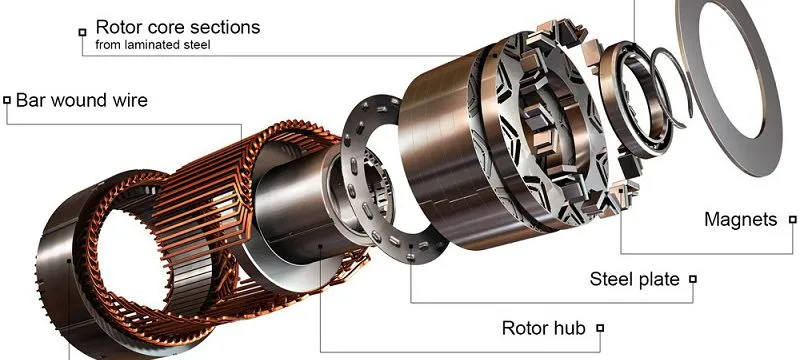
At its core, the motor consists of two main components:
- Stator – The stationary outer part containing windings that generate a rotating magnetic field when energized by alternating current (AC).
- Rotor – The rotating inner component equipped with permanent magnets that interact with the stator’s magnetic field.
When the stator windings are energized, they create a rotating magnetic field. The magnetic field from the rotor’s permanent magnets locks in synchrony with this rotating field, producing smooth and continuous torque. Because the rotor does not require electrical excitation, energy losses associated with rotor currents are significantly reduced, resulting in higher efficiency and improved power density.
One of the defining characteristics of permanent magnet motors is their ability to deliver high torque relative to size. This makes them particularly suitable for applications where space constraints, dynamic response, and energy efficiency are critical. Their design also eliminates the need for brushes or slip rings in most configurations, reducing maintenance requirements and improving operational reliability.
Permanent magnet motors are commonly categorized into two major types:
- Permanent Magnet Synchronous Motors (PMSM): Operate synchronously with the stator’s rotating magnetic field and are widely used in industrial automation and precision motion control.
- Brushless DC Motors (BLDC): Use electronic commutation and are popular in both industrial and commercial applications.
Due to their efficiency, compact structure, and superior controllability, permanent magnet motors are increasingly preferred in advanced manufacturing systems, robotics, CNC machinery, and linear motion platforms.
How Does a Permanent Magnet Motor Work?
A permanent magnet motor operates based on the interaction between a rotating magnetic field generated by the stator and a constant magnetic field produced by permanent magnets embedded in the rotor. This electromagnetic interaction creates torque and drives mechanical motion with high precision and efficiency.
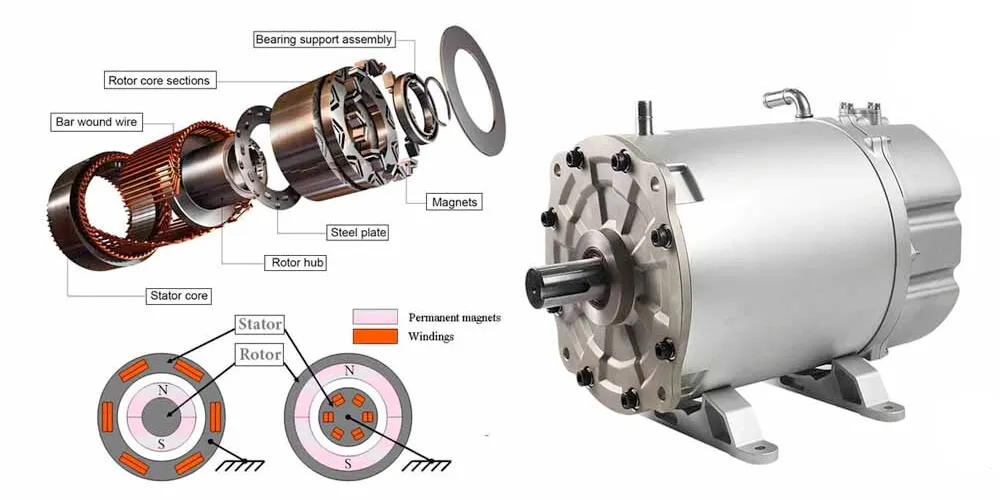
To fully understand the working mechanism, it is helpful to break it down into three core elements: structure, electromagnetic interaction, and control.
1. Core Structure of the Motor
A permanent magnet motor consists of:
- Stator – Contains copper windings arranged in phases. When energized with alternating current (AC), these windings generate a rotating magnetic field.
- Rotor – Equipped with permanent magnets (often made from neodymium or other rare-earth materials). These magnets produce a constant magnetic flux without requiring electrical excitation.
- Air Gap – The small space between the stator and rotor where magnetic coupling occurs.
Unlike induction motors, the rotor in a PM motor does not rely on induced current to generate magnetism. This structural difference is key to its higher efficiency.
2. Electromagnetic Interaction and Torque Production
When three-phase AC power is supplied to the stator windings, a rotating magnetic field is created. This rotating field interacts directly with the fixed magnetic field of the rotor’s permanent magnets.
The fundamental working principle can be summarized as follows:
- The stator produces a rotating magnetic field.
- The rotor’s permanent magnets attempt to align with this rotating field.
- Continuous alignment creates synchronous rotation.
- The magnetic attraction and repulsion between stator and rotor fields generate torque.
In Permanent Magnet Synchronous Motors (PMSM), the rotor rotates at the same speed as the stator’s rotating magnetic field, this is known as synchronous operation. Because there is no slip (as seen in induction motors), energy losses are reduced and torque delivery is smoother.
This direct magnetic coupling enables:
- Higher torque density
- Faster dynamic response
- Reduced rotor energy losses
- Improved overall efficiency
3. Role of Power Electronics and Motor Drives
Modern permanent magnet motors rely heavily on advanced motor drives and inverters for optimal performance.
Since the rotor field is constant, speed and torque are controlled by adjusting:
- Frequency of the AC supply
- Voltage amplitude
- Phase angle
An inverter converts DC power into controlled AC signals, allowing precise electronic commutation and real-time adjustment. In high-performance industrial systems, vector control (field-oriented control) is often used to achieve accurate torque and speed regulation.
This integration of electromagnetic design and intelligent control electronics is what makes permanent magnet motors ideal for precision motion systems, robotics, CNC machinery, and linear motor platforms.
Because the rotor does not require induced current:
- Rotor copper losses are eliminated
- Heat generation is reduced
- Efficiency remains high even at partial loads
- Acceleration and deceleration are more responsive
These performance advantages make permanent magnet motors particularly valuable in applications demanding precision positioning, rapid speed changes, and energy optimization.
Key Advantages of Permanent Magnet Motors
Permanent magnet motors are widely recognized for redefining performance standards in industrial motion systems. By eliminating rotor excitation losses and leveraging high-energy magnetic materials, they deliver a powerful combination of efficiency, precision, and compactness that modern automation demands.
- Exceptional Energy Efficiency: With no rotor current required to create magnetism, copper losses in the rotor are eliminated. This significantly improves overall efficiency, especially under partial-load conditions where many industrial systems operate most of the time.
- High Torque Density: Permanent magnet motors produce more torque per unit volume compared to conventional induction motors. This allows for smaller motor sizes without sacrificing output power, ideal for space-constrained machinery and compact system designs.
- Compact and Lightweight Design: Higher power density means reduced frame size and lower overall system weight. This is particularly valuable in robotics, CNC systems, and high-speed automation platforms.
- Fast Dynamic Response: Thanks to direct magnetic coupling between stator and rotor fields, these motors offer rapid acceleration and deceleration. This enables precise motion control in applications that demand quick positioning and smooth speed transitions.
- Superior Power Factor: Permanent magnet motors typically operate with a higher power factor, reducing reactive power demand and improving electrical system stability.
- Reduced Heat Generation: With fewer electrical losses in the rotor, thermal buildup is minimized. Lower operating temperatures contribute to improved reliability and extended service life.
- Low Maintenance Requirements: Most configurations, such as PMSM and BLDC motors, eliminate brushes and slip rings. This reduces mechanical wear, downtime, and long-term maintenance costs.
- Improved Controllability: When paired with modern inverters and vector control strategies, permanent magnet motors enable highly accurate torque and speed regulation, critical for advanced industrial automation and linear motion systems.
- Energy Savings and Sustainability Benefits: Higher efficiency directly translates into lower energy consumption and reduced operational costs, supporting sustainability goals and carbon footprint reduction initiatives.
Together, these advantages explain why permanent magnet motors have become a preferred solution in high-performance industrial environments. Their ability to combine efficiency, precision, and compact power makes them a strategic choice for next-generation automation and advanced motion control systems.
Permanent Magnet Motor vs Induction Motor
When selecting a motor for industrial applications, one of the most common comparisons is between a permanent magnet motor (PM motor) and an induction motor. While both convert electrical energy into mechanical motion using electromagnetic principles, their internal design, efficiency characteristics, and performance capabilities differ significantly.
Below is a structured comparison to clarify the key distinctions:
| Criteria | Permanent Magnet Motor | Induction Motor |
| Rotor Design | Uses permanent magnets embedded in or mounted on the rotor | Uses conductive rotor bars where current is induced electromagnetically |
| Rotor Excitation | No external excitation required | Requires induced rotor current to create magnetic field |
| Efficiency | Higher efficiency due to elimination of rotor copper losses | Lower efficiency due to rotor losses and slip |
| Torque Density | Higher torque per unit size | Lower torque density for equivalent frame size |
| Slip | Operates synchronously (no slip in PMSM) | Operates with slip between stator field and rotor |
| Power Factor | Typically higher | Generally lower, especially under light loads |
| Thermal Performance | Reduced rotor heating | Higher rotor heat generation |
| Size & Weight | More compact for same output power | Larger for equivalent performance |
| Initial Cost | Higher (due to permanent magnet materials) | Lower upfront cost |
| Maintenance | Low (no brushes, minimal wear components) | Low to moderate depending on design |
Performance Differences in Industrial Applications
Permanent magnet motors excel in applications requiring:
- High precision motion control
- Rapid acceleration and deceleration
- Compact system design
- High energy efficiency
- Stable operation across varying loads
Induction motors, on the other hand, remain widely used in:
- Heavy-duty industrial environments
- Applications where cost sensitivity is high
- Constant-speed operations
- Systems where ultra-high precision is not required
Energy and Long-Term Cost Considerations
Although permanent magnet motors typically involve a higher initial investment due to rare-earth magnet materials, their superior efficiency often results in significant energy savings over time. In continuous-operation industrial environments, reduced power consumption and lower thermal losses can substantially decrease total cost of ownership (TCO).
Induction motors remain a robust and proven technology, but as industries move toward energy optimization, precision automation, and compact machine design, permanent magnet motors are increasingly becoming the preferred solution.
Ultimately, the choice depends on performance requirements, budget constraints, and long-term operational priorities. For high-performance automation and advanced motion systems, permanent magnet motors frequently offer a decisive technical advantage.
Industrial Applications of Permanent Magnet Motors
Permanent magnet motors have become a driving force behind high-performance industrial systems. Their ability to deliver high torque density, rapid dynamic response, and superior energy efficiency makes them an ideal solution for demanding environments where precision and reliability are non-negotiable. Across industries, these motors are enabling smarter, faster, and more energy-optimized operations.
- Industrial Automation Systems: From automated assembly lines to high-speed packaging machines, permanent magnet motors provide precise speed and torque control, ensuring consistent product quality and reduced cycle times.
- Robotics and Articulated Arms: Their compact size and high torque output make them perfect for robotic joints, where smooth motion, rapid acceleration, and accurate positioning are critical.
- CNC Machines and Precision Machining: High dynamic performance allows for tight positioning accuracy, improved surface finish, and enhanced repeatability in milling, cutting, and drilling operations.
- Linear Motion Platforms and Linear Motor Systems: When integrated into advanced motion solutions, permanent magnet technology supports high acceleration, stable thrust generation, and micron-level positioning accuracy.
- Electric Vehicles (EVs) and Mobility Systems: Widely used in traction systems due to their high efficiency, lightweight structure, and strong torque performance across wide speed ranges.
- HVAC Systems and Compressors: Improved part-load efficiency significantly reduces energy consumption in climate control and industrial cooling systems.
- Pumps and Industrial Fans: High power factor and energy efficiency make them ideal for continuous operation environments where electricity cost optimization is essential.
- Renewable Energy Systems: Applied in wind turbines and energy conversion systems where efficient mechanical-to-electrical energy transformation is required.
- Semiconductor and High-Tech Manufacturing: Clean operation, minimal heat generation, and precise control are crucial for contamination-sensitive and high-precision production environments.
What connects all these applications is a common requirement: controlled power delivered with efficiency and precision. Permanent magnet motors meet that demand by combining advanced electromagnetic design with intelligent drive control. As industries continue to prioritize automation, sustainability, and performance optimization, their role in modern industrial ecosystems will only become more central and strategic.
Conclusion
Permanent magnet motors combine high efficiency, compact design, and precise controllability, making them a powerful solution for modern industrial motion systems. By eliminating rotor losses and delivering superior torque density, they outperform traditional motor technologies in applications that demand accuracy, speed, and energy optimization.
As industries continue to advance toward smarter automation and sustainable operations, permanent magnet motors are not just an alternative, they are increasingly the standard for high-performance motion control.