




In modern industrial automation, temperature is more than just a measurement, it is a critical factor that directly impacts performance, precision, and equipment lifespan. From linear motors and servo systems to high-speed automation lines, even slight thermal variations can lead to inefficiency, component degradation, or unexpected downtime. That’s why selecting the right temperature sensor is not just a technical decision, but a strategic one. In this article, we explore the 4 most common types of temperature sensor, their working principles, strengths, and how they support reliable thermal management in advanced industrial systems.
What Is a Temperature Sensor?
A temperature sensor is a device that detects and measures thermal energy within a system and converts it into a readable signal, typically electrical for monitoring, control, or protection purposes. In industrial environments, temperature sensors play a critical role in maintaining operational stability, preventing overheating, and ensuring optimal performance of machinery such as linear motors, servo drives, and motion control systems.
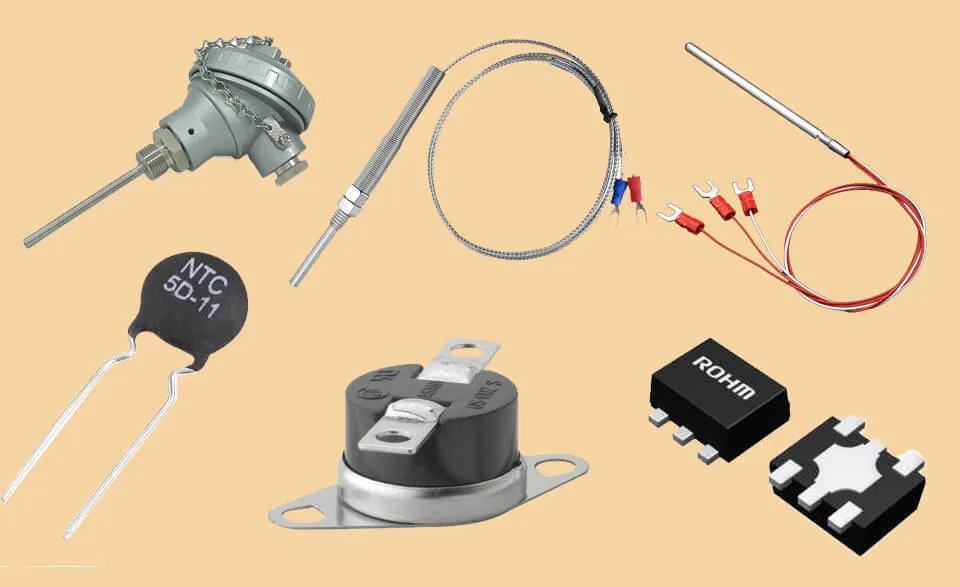
At its core, temperature is a physical quantity that reflects the average kinetic energy of particles within a material. A temperature sensor works by responding to changes in this energy through measurable physical properties such as voltage generation, electrical resistance variation, or infrared radiation emission. These changes are then translated into analog or digital signals that can be processed by controllers, PLCs, or embedded motor control systems.
How Temperature Sensors Work
Different sensor technologies rely on different physical principles:
- Some sensors generate a voltage when exposed to temperature differences.
- Others change their electrical resistance as temperature varies.
- Non-contact sensors detect infrared radiation emitted by objects.
Regardless of the method, the goal remains the same: provide accurate and reliable temperature data that can be used for real-time monitoring and automated control decisions.
In high-performance systems like linear motors, temperature feedback allows control algorithms to compensate for thermal expansion, adjust current levels, and protect windings from overheating, all of which contribute to improved efficiency and extended service life.
Contact vs. Non-Contact Temperature Sensors
Temperature sensors can generally be divided into two main categories:
1. Contact Sensors
These sensors must be physically attached to or inserted into the object being measured. They provide highly accurate readings and are commonly used in industrial motor assemblies and embedded thermal protection systems.
Examples include:
- RTDs
- Thermocouples
- Thermistors
2. Non-Contact Sensors
These measure temperature from a distance by detecting infrared radiation. They are ideal for moving components, high-speed machinery, or environments where direct contact is impractical.
Infrared temperature sensors are commonly used in automated production lines and dynamic motion systems.
In motion control and linear motor applications, temperature directly influences:
- Copper winding resistance
- Magnetic performance
- Positioning accuracy
- Bearing lifespan
- System safety
Without proper thermal monitoring, excessive heat can reduce efficiency, cause insulation failure, and lead to unexpected downtime. By integrating temperature sensors into motor control architectures, engineers can enable predictive maintenance, improve thermal management strategies, and ensure long-term reliability.
In short, a temperature sensor is not just a measuring device, it is a foundational component of modern industrial intelligence, enabling smarter, safer, and more efficient automation systems.
The 4 Most Common Types of Temperature Sensor
Not all temperature sensors are created equal. In industrial automation, especially in high-precision systems like linear motors, the choice of sensor can directly influence control accuracy, thermal stability, and overall system lifespan. Understanding how each sensor works, where it excels, and where it falls short is essential for making the right engineering decision.
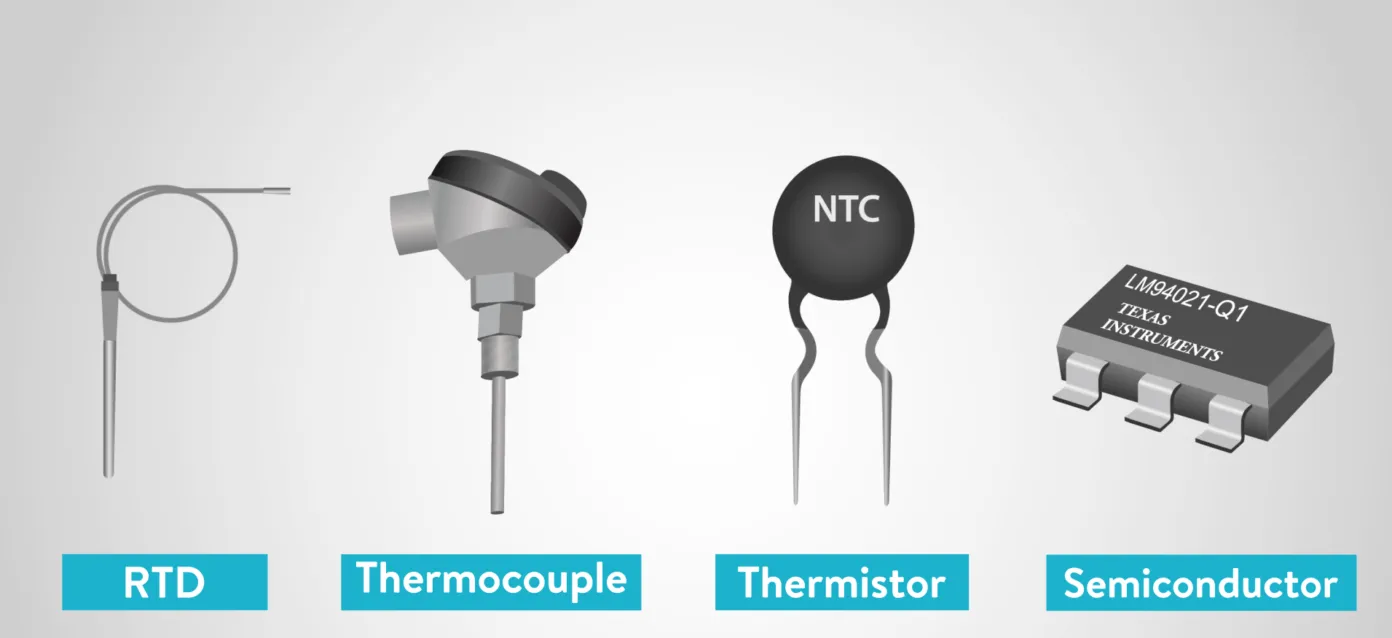
Below are the four most common types of temperature sensor used across industrial and motion control applications.
Thermocouple
Thermocouples are among the most widely used temperature sensors in industrial environments. They operate based on the Seebeck effect, where two different metals joined together generate a voltage when exposed to a temperature difference.
What makes thermocouples particularly powerful is their extremely wide temperature range, from very low cryogenic levels to over 1,800°C, depending on the type. This makes them ideal for harsh environments such as furnaces, heavy machinery, and high-power motor systems.
Why engineers choose thermocouples:
- Extremely wide temperature range
- Fast response time
- Durable and vibration-resistant
- Cost-effective
Limitations to consider:
- Lower accuracy compared to RTDs
- Requires cold junction compensation
- Signal can be sensitive to electrical noise
In motor systems, thermocouples are often used for monitoring stator or coil temperatures in demanding environments where robustness matters more than ultra-high precision.
RTD (Resistance Temperature Detector)
RTDs measure temperature by correlating the resistance of a metal, typically platinum, with temperature changes. As temperature increases, resistance increases in a predictable and highly linear manner.
Among all contact temperature sensors, RTDs are known for their superior accuracy and long-term stability. This makes them ideal for applications requiring precise thermal control.
Key advantages:
- High accuracy and repeatability
- Excellent long-term stability
- Predictable and linear response
Potential drawbacks:
- More expensive than thermocouples
- Slightly slower response time
- Less tolerant to extreme vibration
In high-precision motion systems such as linear motors, RTDs are commonly integrated to ensure tight thermal regulation. Even small temperature variations can affect copper resistance, magnetic performance, and positioning accuracy, areas where RTDs truly shine.
Thermistor
Thermistors are temperature-sensitive resistors typically made from ceramic or polymer materials. They are available in two primary types:
- NTC (Negative Temperature Coefficient): resistance decreases as temperature increases
- PTC (Positive Temperature Coefficient): resistance increases as temperature rises
Thermistors are known for their exceptional sensitivity within a limited temperature range, making them highly effective for monitoring specific thermal thresholds.
Strengths:
- Very high sensitivity
- Fast response time
- Compact size
- Cost-efficient
Limitations:
- Narrow temperature range
- Non-linear response curve
- Less suitable for extreme environments
Thermistors are commonly embedded directly into compact motor assemblies for real-time thermal protection. In applications where fast detection of overheating is critical, thermistors provide a rapid and reliable solution.
Infrared (IR) Temperature Sensor
Unlike the previous three, infrared temperature sensors measure temperature without physical contact. They detect infrared radiation naturally emitted by objects and convert it into temperature readings.
This makes IR sensors ideal for moving parts, rotating components, or high-speed automation systems where contact measurement is impractical.
Advantages:
- Non-contact measurement
- Extremely fast response
- Safe for hazardous environments
- No mechanical wear
Challenges:
- Accuracy depends on emissivity settings
- Sensitive to dust, steam, or optical interference
- Typically higher cost
In advanced automation systems and high-speed linear motion platforms, IR sensors allow real-time surface temperature monitoring without interrupting movement, a significant advantage in precision manufacturing.
Each of these four temperature sensor types serves a different purpose:
- Thermocouples dominate in extreme industrial environments.
- RTDs lead in precision-driven applications.
- Thermistors excel in compact, responsive systems.
- Infrared sensors provide flexibility for dynamic and non-contact measurement.
In linear motor and motion control applications, the right sensor selection directly affects thermal management, performance stability, and equipment longevity. Selecting based solely on cost can lead to inaccurate readings, inefficient control, or premature component failure.
Understanding these four core technologies empowers engineers to design smarter, safer, and more reliable industrial systems.
How to Choose the Right Temperature Sensor for Linear Motor Applications
Selecting a temperature sensor for linear motor systems is not simply about measuring heat, it is about protecting performance, preserving precision, and extending system lifespan. In high-speed, high-accuracy motion platforms, even minor thermal fluctuations can influence copper resistance, magnetic force stability, and positioning accuracy.
To ensure optimal performance, engineers must evaluate multiple technical factors before choosing the right temperature sensing solution.
Define the Operating Temperature Range
The first and most fundamental step is identifying the expected temperature range within the linear motor system.
Linear motors generate heat primarily from:
- Copper winding losses
- Continuous high current loads
- Ambient environmental conditions
- Mechanical friction in adjacent components
If the application involves high thermal stress or wide temperature fluctuations, thermocouples may be suitable due to their broad operating range. However, for precision-controlled systems operating within a narrower temperature window, RTDs or thermistors often provide better measurement accuracy.
Choosing a sensor outside its optimal range can lead to inaccurate readings and unreliable thermal protection.
Determine Required Accuracy and Stability
Linear motors are often used in precision applications such as semiconductor manufacturing, medical equipment, or automated inspection systems. In these environments, even slight temperature drift can affect positioning repeatability.
Ask the following:
- How critical is thermal accuracy to positioning performance?
- Is long-term measurement stability required?
- Will the system run continuously for extended periods?
For ultra-precise control systems, RTDs are typically preferred due to their high accuracy and stable, linear response. If the primary goal is overheat protection rather than precision control, thermistors may offer a cost-effective alternative.
Evaluate Response Time Requirements
In dynamic motion systems, heat can build up quickly during acceleration or high-load cycles. A slow sensor may delay corrective actions from the control system.
Consider:
- How quickly can the system temperature rise?
- Does the motor operate in rapid start-stop cycles?
- Is real-time compensation required?
Thermistors and thermocouples generally offer faster response times, while RTDs prioritize accuracy over speed. In high-speed linear motor applications, fast detection can prevent sudden overheating and reduce the risk of insulation damage.
Consider Environmental Conditions
Industrial environments introduce challenges that can affect sensor performance:
- Vibration from motion platforms
- Electrical noise from drives and inverters
- Dust, coolant, or humidity exposure
- Electromagnetic interference (EMI)
Thermocouples are highly robust and perform well in harsh environments. RTDs, while precise, may require better shielding and installation care. Infrared sensors, although non-contact, may be affected by dust or reflective surfaces.
The sensor must match not only thermal requirements but also environmental realities.
Integration with Motor Control Systems
Modern linear motor systems rely on closed-loop control architectures. Temperature feedback may be used for:
- Current limiting
- Thermal compensation algorithms
- Predictive maintenance analytics
- Safety shutdown mechanisms
Before selecting a sensor, ensure compatibility with:
- PLC or motion controller input type
- Analog vs. digital output requirements
- Signal conditioning needs
- Wiring distance and signal integrity
Poor integration planning can lead to signal noise, inaccurate readings, or unnecessary system complexity.
Balance Cost with Long-Term Reliability
While cost is always a consideration, it should not outweigh reliability and system performance. A low-cost sensor that fails prematurely or provides unstable readings can lead to downtime far more expensive than the sensor itself.
When evaluating cost, consider:
- Installation complexity
- Calibration requirements
- Expected lifespan
- Maintenance frequency
In many high-performance linear motor systems, investing in a higher-grade sensor yields measurable long-term benefits in uptime and precision.
In linear motor applications, temperature is directly linked to force consistency, magnetic integrity, and dimensional stability. Effective sensor selection enables:
- Stable thrust performance
- Reduced thermal drift
- Extended insulation lifespan
- Improved operational safety
Choosing the right temperature sensor is not merely a hardware decision, it is a strategic component of intelligent motion system design.
By carefully evaluating range, accuracy, response time, environment, integration, and lifecycle cost, engineers can implement a thermal monitoring solution that supports both immediate performance and long-term reliability.
Temperature Sensors in Linear Motor Systems
In linear motor systems, temperature is not just a background variable, it is a dynamic force that directly influences thrust consistency, positioning accuracy, and overall system reliability. Effective thermal monitoring transforms a standard motion platform into an intelligent, self-protecting system.
Below are the key ways temperature sensors integrate into and enhance linear motor performance:
- Real-time coil temperature monitoring enables immediate detection of overheating in stator windings, preventing insulation breakdown and protecting long-term motor integrity.
- Thermal compensation for precision positioning allows motion controllers to adjust parameters based on temperature fluctuations, minimizing thermal drift and maintaining micron-level accuracy in high-end automation systems.
- Current limiting and protection control uses temperature feedback to dynamically regulate current output, reducing the risk of excessive heat buildup during peak load or rapid acceleration cycles.
- Magnetic performance stabilization ensures that permanent magnets operate within safe thermal limits, preserving magnetic strength and consistent thrust output over time.
- Predictive maintenance integration supports smart diagnostics by identifying abnormal temperature trends before failure occurs, reducing unexpected downtime and extending equipment lifespan.
- Surface temperature monitoring with non-contact sensors enables safe measurement of moving components or high-speed platforms without interrupting motion.
- Improved energy efficiency results from optimized thermal control, as excessive heat often signals energy losses that can be corrected through smarter feedback systems.
- Enhanced safety compliance ensures systems meet industrial safety standards by triggering alarms or controlled shutdowns when critical temperature thresholds are exceeded.
When properly integrated, temperature sensors do far more than measure heat, they become a core element of intelligent motion control architecture. In advanced linear motor systems, thermal management is performance management. By leveraging accurate, responsive temperature sensing, engineers can achieve higher precision, longer lifespan, and greater operational stability across demanding industrial applications.
Conclusion
Temperature may be invisible, but its impact on industrial performance is undeniable. From protecting motor windings to preserving magnetic stability and ensuring micron-level positioning accuracy, the right temperature sensor plays a critical role in every high-performance motion system. Understanding the four most common types, thermocouples, RTDs, thermistors, and infrared sensors, empowers engineers to make informed decisions based on precision, durability, response time, and environmental demands.
In linear motor applications, thermal control is not simply about preventing overheating. It is about maintaining consistent thrust, minimizing thermal drift, optimizing energy efficiency, and extending system lifespan. A well-chosen temperature sensor transforms raw thermal data into actionable intelligence, enabling smarter control strategies, predictive maintenance, and long-term operational reliability.

